Haulage Physics Engine — First-Principles Truck Simulation
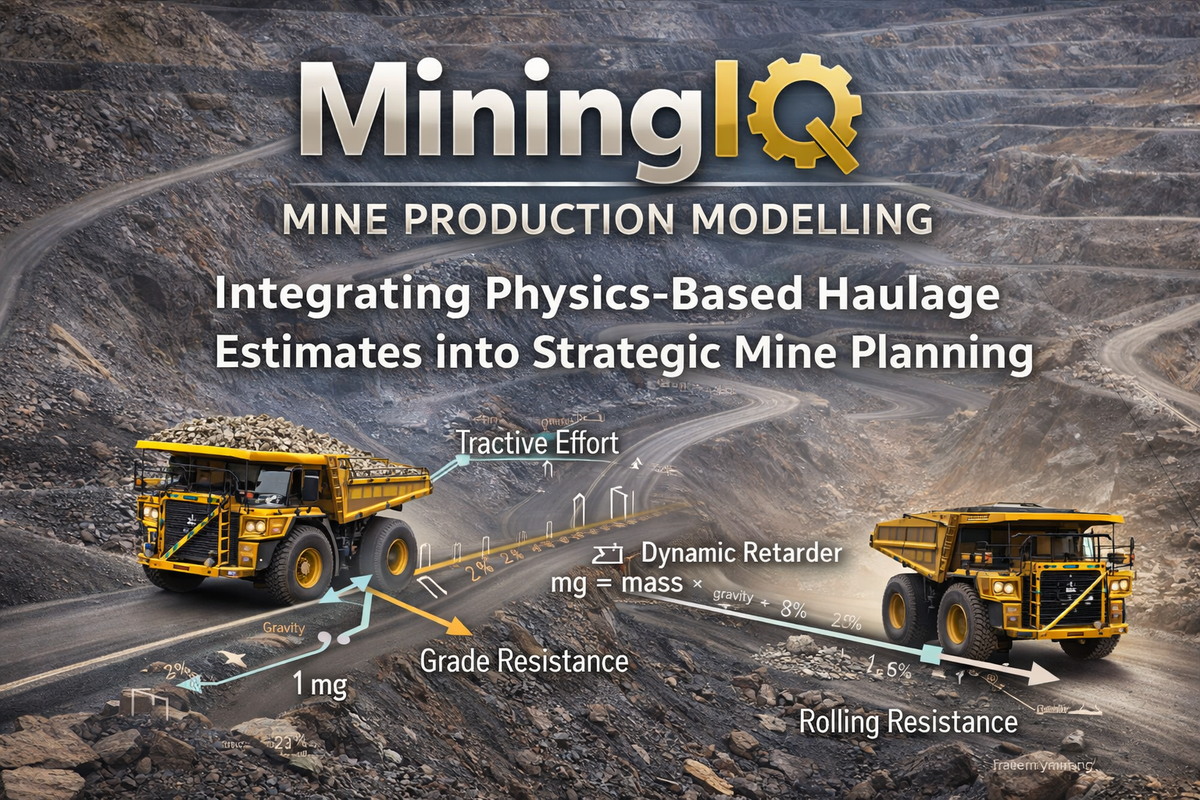
MiningIQ's haulage physics engine is a segment-by-segment kinematic simulator. There is no averaging, no flat-haul approximation — every gradient change, every corner, every road surface type affects the result. Each truck traverses a route built from 3D haul road profiles, and the engine resolves forces, speeds, and travel times using OEM rimpull and retarder curves. The output is a physics-derived cycle time that feeds directly into pit optimisation, scheduling, fleet sizing, and financial modelling.
Physics Engine Pipeline
From project configuration to per-block haulage cost
SimConfig — Per-Project Physics Parameters
All physics constants loaded from database settings: gravity, rolling resistance per road class, speed caps (loaded/empty, ramp, corner bands), lookahead braking distance, comfort deceleration, calibration factor, and coefficient of traction. Multiple projects with different site configs coexist without interference.
Truck Model — OEM Performance Data
Each truck type defined by rimpull curve (force vs speed), retarder curve (braking force vs speed), physical limits (empty mass, payload, max speeds), and tray volume for volume-constrained payload calculation. Forces interpolated via numpy at any speed.
Route Geometry Pre-Processing
XYZ point arrays converted to per-segment lengths, gradients, and bearings. Long segments refined into equal sub-segments. Flat buffer segments prepended and appended for acceleration/deceleration zones. Empty return trip reverses segments and negates gradients.
Regulatory Speed Caps
Per-segment speed caps from the most restrictive of: road class caps, ramp caps (downhill vs uphill), multi-band corner caps with influence zones, truck vmax, and final-segment deceleration cap for loading/dumping position.
Forward Pass — First-Principles Kinematics
Single forward pass through all segments computing resistive force from mass, gravity, grade, and rolling resistance. Acceleration or braking resolved from rimpull/retarder curves. Look-ahead anticipatory braking prevents overshooting into low-speed zones. Short segments use average-velocity convention.
Cycle Simulation & Block Integration
Full cycle runs the forward pass twice — loaded and empty. Pre-computed route cycle times stored per (fleet, bench). Per-block haulage cost is a fast lookup plus flat-haul addition. Costs flow into MCAF for pit optimisation — deeper benches with longer hauls directly affect pit shell boundaries.
Key Technical Capabilities
First-Principles Kinematics
Segment-by-segment forward pass through the full route. Every gradient change, corner, and surface type resolved individually — no averaging across the route.
OEM Rimpull & Retarder Curves
Tractive effort and dynamic braking capacity interpolated directly from manufacturer performance data at any speed. Traction-limited on slippery surfaces via configurable coefficient of traction.
Multi-Band Corner Speed Control
Bearing changes trigger speed restrictions across configurable angle bands with an influence zone extending either side of the apex. Smooth deceleration into and acceleration out of corners.
Anticipatory Braking
Look-ahead scan (default 40 m) computes maximum safe entry speed for comfortable braking to any lower cap ahead. Trucks decelerate smoothly into speed-restricted zones.
Per-Project Calibration
Configurable calibration factor adjusts deterministic physics against real-world performance — operator variability, minor delays, road condition variance. Every physics parameter configurable per project.
Three-Layer Block Model Integration
Pre-computed route cycle times (expensive, once) feed per-block haulage cost lookups (fast, per block). Haulage costs flow into MCAF for pit optimisation — deeper benches with longer hauls directly affect pit shell boundaries.
Download the Full Technical Overview
The complete technical document covers the physics engine in detail — from SimConfig parameters through to cycle simulation outputs and block model integration.
Want to See the Physics Engine in Action?
We can run a demonstration using your haul road profiles and truck fleet data. Get in touch to discuss how first-principles haulage simulation integrates into your mine planning workflow.